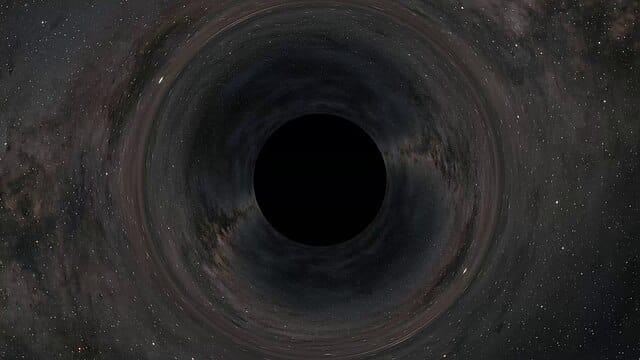
Some discoveries unfold silently, doing not have remarkable surges or cool conclusions. Astronomers observed a far-off flare from a remote galaxy, a phenomenon that takes place when a star endeavors too near something it should not. The data appeared strange– uncommon however not inaccurate. Signals changed when they need to have stayed steady, and ultimately, a pattern emerged. Something was moving that should not have actually moved so easily; it appeared as though area itself remained in movement. What followed was not a quick overhaul of physics however a progressive affirmation of an old theory proposed by Einstein almost a century back. Just now has deep space supplied proof that comes close to evidence.
Deep Space Seems Twisted by Great Voids
The occasion started with a star being torn apart as it wandered too near a supermassive great void, leading to streams of gas. Rather of falling straight in, this product circled, warmed up, and formed a luminescent disc. Jets of matter were ejected at amazing speeds. This phenomenon is called a tidal disturbance occasion, and while astronomers have actually experienced others previously, this one was special due to its movement. The disc and jets did not stay fixed; they wobbled together in an integrated way over a cycle of around twenty days. This collaborated motion recommended an external impact– not an accident or surge, however a constant pull triggered by the rotation itself.
Why the Twisting of Area is Substantial
Einstein anticipated that a turning things ought to drag area and time together with it. While this idea might appear abstract, it has concrete ramifications. Near a great void, the impact ought to be noticable. Previously, it had actually just been presumed, never ever plainly observed. In this circumstances, the wobble lined up with theoretical expectations from a spinning great void misshaping spacetime around it. This phenomenon is called frame dragging, showing that area is not simply a fixed background; it can move, flex, and circulation when mass and spin are adequately strong. Observing this in a genuine cosmic context provides credence to formulas developed long before the arrival of contemporary telescopes.
How Telescopes Detected Such a Subtle Signal
The signal was not noticeable in simply one kind of light. Scientists, who released their findings in Science Advances, integrated X-ray information from a NASA area telescope with radio observations from a big ground-based variety. Together, they recognized modifications that differed previous occasions of the exact same nature. The light flickered in a way that recommended motion instead of mayhem. Spectral analysis exposed that the disc of particles and the jets were precessing in unison. This shared rhythm was important, eliminating easier descriptions and pointing back to spacetime itself being dragged by the great void’s spin. This was not simple speculation; it was a constant pattern observed throughout various instruments and gradually.
What This Exposes About Great Voids and deep space
Great voids are frequently viewed as the endpoints of cosmic stories– locations where matter disappears. This observation recommends a more vibrant function. Spin impacts habits, impacting how matter accretes, how jets are formed, and how energy gets away. The twisting of spacetime effects whatever in distance. Comprehending this phenomenon improves our designs of galaxy development and the interactions in between great voids and their environments. It likewise shows that a few of deep space’s most severe forecasts are not simply mathematical interests; they can be observed when perseverance and timing align.
This discovery does not conclude a chapter; it leaves the narrative somewhat open. Area twists, time shifts, and in the range, the damage of a star silently verifies a concept that has actually waited for over a century for recognition.
Read other such interesting post