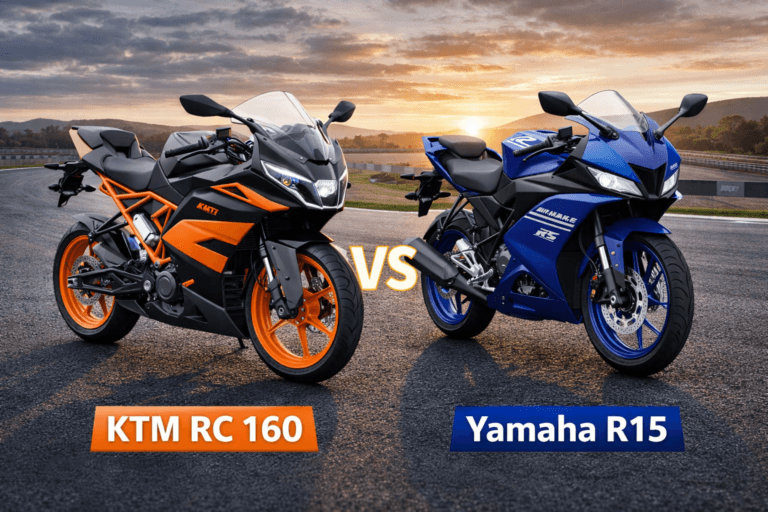
The KTM RC 160 and Yamaha R15 are among India’s most popular entry‑level fully‑faired sportbikes. Both appeal to young riders who want sporty design, peppy performance, and daily usability, but they have different strengths in engineering, character, and feature sets.
Below is a comprehensive, side‑by‑side comparison of both bikes — perfect for anyone deciding which one to choose.
📅 Launch & Market Position
| Attribute | KTM RC 160 | Yamaha R15 |
|---|---|---|
| Launched in India | 8 January 2026 | 2011 (multiple iterations) |
| Category | Entry‑level faired sportbike | Entry‑level faired sportbike |
| Target Rider | Performance‑focused urban & track | Balanced sport + commuter |
The KTM RC 160 is KTM’s newest competitor in the sportbike segment, while the Yamaha R15 has been a long‑time favorite with a strong fan following.
🏍️ Engine & Performance
| Specification | KTM RC 160 | Yamaha R15 |
|---|---|---|
| Engine Type | 164.2 cc, liquid‑cooled, SOHC | 155 cc, liquid‑cooled, SOHC |
| Max Power | ~19 PS @ 9,500 rpm | ~18.4 PS @ 10,000 rpm |
| Max Torque | ~15.5 Nm @ 7,500 rpm | ~14.2 Nm @ 8,500 rpm |
| Transmission | 6‑speed with Assist & Slipper Clutch | 6‑speed with Assist & Slipper Clutch |
| Top Speed | ~118 km/h (approx.) | ~135 km/h (approx.) |
| Engine Character | Punchy mid‑range, sport bias | Rev‑happy & smooth |
💡 Summary:
The KTM RC 160 produces slightly more torque and power in the mid‑range, making it feel quicker off the line at street speeds. The Yamaha R15 tends to rev higher and offers a more refined feel at higher RPMs.
📊 Chassis, Suspension & Braking
| Component | KTM RC 160 | Yamaha R15 |
|---|---|---|
| Frame | Trellis frame | Deltabox frame |
| Front Suspension | 37 mm inverted (USD) forks | Telescopic (R15 V2) / USD forks (newer R15 models) |
| Rear Suspension | Monoshock | Link‑type monocross |
| Front Brake | 320 mm disc | 282 mm disc |
| Rear Brake | 230 mm disc | 220 mm disc |
| ABS | Dual‑channel ABS + Supermoto mode | Dual‑channel ABS |
| Wheel Size | 17‑inch alloys | 17‑inch alloys |
| Tires | 110/70‑17 front, 140/60‑R17 rear | 100/80‑17 front, 140/70‑17 rear |
💡 Summary:
The RC 160’s larger front disc and inverted forks give it an edge in braking confidence and aggressive handling, especially under hard riding.
The R15’s Deltabox frame contributes to a very stable and predictable chassis feel, especially on highways and corners.
📐 Ergonomics & Comfort
| Attribute | KTM RC 160 | Yamaha R15 |
|---|---|---|
| Riding Posture | Aggressive sport stance | Slightly sporty yet commuter‑friendly |
| Seat Type | Split seat | Split seat |
| Tank Capacity | 13.75 L | ~11 L |
| Weight | Light | Light |
| Usability | Sport + occasional touring | Sport + daily commuting |
💡 Summary:
The R15 offers a marginally more comfortable upright compromise for city and highway.
The RC 160 leans a bit more towards a true sportbike posture, which rewards spirited riding but may be firmer on longer commutes.
📱 Features & Instrumentation
| Feature | KTM RC 160 | Yamaha R15 |
|---|---|---|
| Instrument Console | LCD display | Fully digital / TFT (depends on version) |
| Lighting | Full LED | Full LED |
| Clutch | Assist & Slipper | Assist & Slipper |
| Ride Modes | N/A (Supermoto ABS mode) | N/A |
| Connectivity | Navigation support (on select trims) | Smartphone connectivity (on newer R15 variants) |
| Special Modes | Supermoto ABS mode | Standard ABS |
💡 Summary:
Both bikes come with modern LED lighting and digital consoles, but the R15’s newer versions include smartphone connectivity and more refined dash interfaces. KTM’s Supermoto ABS mode is a unique feature that allows experienced riders greater control in controlled slide or rear‑bias braking scenarios.
🛡️ Safety & Rider Aids
| Safety Feature | KTM RC 160 | Yamaha R15 |
|---|---|---|
| Dual‑Channel ABS | Yes (Supermoto mode) | Yes |
| Assist & Slipper Clutch | Yes | Yes |
| Disc Brakes Front & Rear | Yes | Yes |
| Tire Pressure & Stability | Standard | Standard |
💡 Summary:
Both bikes enhance rider control and safety with dual‑channel ABS and assist & slipper clutches, which are especially useful for spirited riding and sudden deceleration.
🔋 Fuel & Mileage
| Aspect | KTM RC 160 | Yamaha R15 |
|---|---|---|
| Fuel Tank Capacity | 13.75 L | ~11 L |
| Expected Mileage | ~45–50 km/l | ~45–55 km/l |
| Real‑World Range | ~620–690 km per tank | ~500–580 km per tank |
💡 Summary:
The R15’s smaller tank and efficient engine typically deliver slightly better mileage figures, whereas the RC 160’s larger tank offers a better range per fill.
💰 Pricing (Approx. Ex‑Showroom India)
| Variant | KTM RC 160 | Yamaha R15 |
|---|---|---|
| Standard | ₹1.85 Lakh | ₹1.66 Lakh |
| Feature variants | Premium sport trims | Standard / Connected variants |
(Prices are approximate and can vary by city & dealer.)
💡 Summary:
The R15 is generally more affordable, while the RC 160 commands a slight premium for its advanced hardware and larger brake components.
📌 Quick Strengths & Weaknesses
⭐ KTM RC 160 — Strengths
✔ Strong mid‑range torque & aggressive power delivery
✔ Inverted front forks & bigger brake discs
✔ Supermoto ABS mode adds riding flexibility
✔ Sport‑focused chassis and stance
Weaknesses
✘ Slightly firmer ride for daily commuting
✘ Pricier than R15
⭐ Yamaha R15 — Strengths
✔ Refined engine with high‑RPM fun
✔ Lighter overall weight and efficient mileage
✔ Proven reliability and strong resale value
✔ Comfortable daily usability
Weaknesses
✘ Smaller front disc & simpler suspension
✘ Less aggressive handling edge compared to RC 160
🏁 Which One Should You Choose?
Choose KTM RC 160 if:
✔ You want greater braking & cornering confidence
✔ You enjoy aggressive riding or weekend rides
✔ You prefer robust mechanical hardware
Choose Yamaha R15 if:
✔ You prefer a more balanced everyday sportbike
✔ You want slightly better mileage and range
✔ You favor comfort + performance synergy
🧠 Final Verdict
Both bikes are excellent choices in the entry‑level sportbike category, but they serve slightly different rider profiles:
The KTM RC 160 leans more towards sporty performance and control, ideal for riders who want a sharper edge.
The Yamaha R15 remains a balanced sport option with great mileage, smooth engine character, and everyday comfort.
Either way, buyers get a modern, feature‑packed sportbike with strong safety systems and performance credentials.
Note:- Image used is AI generated.