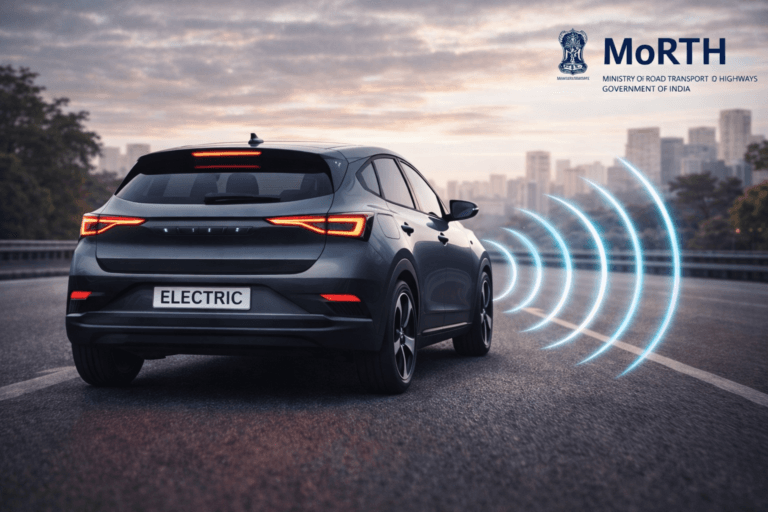
India’s electric mobility landscape is speeding ahead, but a growing concern has emerged with the near‑silent operation of electric vehicles (EVs): pedestrian and road safety. To address this, the Ministry of Road Transport & Highways (MoRTH) has introduced a major safety regulation requiring electric vehicles to be equipped with an Acoustic Vehicle Alerting System (AVAS). This regulation is designed to make EVs produce a sound at low speeds, helping pedestrians, cyclists and other road users detect their presence and avoid accidents.
The rule is part of wider amendments to India’s vehicle safety framework and aligns with global practices that recognise the need for making quiet vehicles more noticeable in urban traffic. The draft notification has been published and is expected to be finalised soon, with clear compliance timelines for new and existing EVs.
What Is AVAS and Why Is It Needed?
Acoustic Vehicle Alerting System (AVAS) is a technology that generates an artificial audible sound from an electric vehicle when it is moving at low speeds (typically up to around 20–30 km/h), reversing, or during specific manoeuvres. This system uses external speakers to emit this sound, which varies with speed, mimicking characteristics that a traditional internal combustion engine (ICE) vehicle would naturally produce.
Need for AVAS
Electric vehicles are almost silent at low speeds, especially in urban areas where pedestrians and cyclists are prevalent. While quiet EVs reduce noise pollution, this very silence can make it difficult for people to detect an approaching vehicle, particularly:
Pedestrians
Cyclists and two‑wheeler riders
Visually impaired individuals
Children and elderly road users
This lack of sound increases the risk of accidents, especially at crossings, parking lots or near traffic signals. AVAS aims to reduce these safety concerns by ensuring EVs are heard before they are seen, improving overall road safety.
Timeline & Implementation Details
MoRTH’s draft amendment to the Central Motor Vehicles Rules (CMVR) specifies phased compliance deadlines for the AVAS mandate. These deadlines apply to different categories of electrified vehicles and are based on when the vehicle model is launched or currently available:
| Compliance Category | Requirement | Timeline |
|---|---|---|
| New EV Models | Must be fitted with AVAS when manufactured | From 1 October 2026 |
| Existing EV Models | Must retrofit or new production must include AVAS | By 1 October 2027 |
| Vehicle Categories Covered | Passenger EVs (M Category), Goods EVs (N Category), e‑rickshaws/e‑karts (L5/L7) | 2026–2027 timelines apply |
The draft rules are part of the Central Motor Vehicles (01st Amendment) Rules, 2026, which also include updates to expand covered vehicle categories — like electric three‑wheelers and carts — alongside standard passenger and commercial EVs.
How AVAS Works: Technical Basics
An AVAS system typically consists of:
External Sound Modules: Speakers mounted on the vehicle’s body or chassis that emit warning sounds.
Control Unit: Integrates with vehicle speed sensors and powertrain controls to adjust sound intensity and frequency based on speed.
Audibility Standards: Rules specify sound levels and frequency ranges to ensure the sound is noticeable without causing disturbance.
AVAS activates when the vehicle moves at low speed or reverses, and automatically switches off at higher speeds where tyre and wind noise become sufficient. The exact sound profile and audibility must meet standards such as AIS‑173, which provide benchmarks for sound pressure levels, frequency range and duration.
Which Vehicles Will Be Affected?
The AVAS requirement applies to a broad spectrum of electrified vehicles, including:
1. Passenger and Commercial EVs
Electric cars
Electric buses
Electric trucks and goods vehicles
2. Light Electric Vehicles
E‑rickshaws
E‑carts (L5/L7 categories)
Similar low‑speed EV classes
Previously, regulations focused primarily on cars and heavier EVs (Category M and N), but recent amendments propose extending the AVAS requirement to light electric vehicles like e‑rickshaws and e‑karts, recognising the safety concerns for these increasingly common urban EVs.
What the Timeline Means for Manufacturers
For vehicle manufacturers, the AVAS mandate introduces a clear compliance roadmap:
New EV Models: Any electric vehicle developed after 1 October 2026 must have AVAS installed at the factory as part of the vehicle design.
Existing Models: Vehicles already in production must incorporate AVAS by 1 October 2027 if they remain in production, or risk regulatory non‑compliance.
Testing and Certification: OEMs must ensure AVAS systems meet the audibility and performance criteria outlined in AIS‑173 (or its updates) before vehicle certification.
These timelines give manufacturers time to redesign platforms, integrate AVAS hardware and software, and validate systems in accordance with safety protocols.
Government Objective and Safety Impact
The AVAS mandate is part of a broader government push to improve road safety while promoting electric mobility. Quiet EVs were identified as a potential hazard due to low noise levels at lower speeds, especially in congested urban areas where pedestrians and other vulnerable road users interact with traffic.
By mandating AVAS, India’s road safety authorities aim to:
Reduce pedestrian accidents involving EVs
Ensure consistent audible warnings at low speeds
Bring India’s EV safety standards in line with international norms
Countries such as the United States, European Union member states, and Japan already require similar alert systems for hybrid and electric vehicles. The Indian regulation aligns domestic safety policy with global practices, fostering safer urban mobility.
Timeline Summary
Here is a quick reference timeline for the AVAS mandate:
| Date | Regulatory Event |
|---|---|
| 29 September 2025 | Draft notification to amend Central Motor Vehicles Rules published. |
| 1 October 2026 | AVAS mandatory for all new EV models. |
| 1 October 2027 | AVAS requirement applies to existing EV models. |
This phased approach allows industry adaptation while prioritising pedestrian safety.
Public Consultation & Feedback
The draft notification issued by MoRTH called for public consultation, inviting suggestions and objections within a specified period before the final rule is notified in the Official Gazette. Such consultations are typical for regulatory changes that have industry and user impact.
Impact on EV Adoption & Industry
The AVAS mandate is expected to have several implications:
Positive Effects
Enhanced pedestrian safety in cities
Standardisation of EV safety systems
Stronger public confidence in EV mobility
Harmony with global EV safety standards
Transitional Challenges
OEM design and integration cost
Testing and certification overhead
Retrofitting existing platforms before deadlines
Nevertheless, the long‑term safety benefits are expected to outweigh the transitional costs, particularly in high‑population urban centres.
Conclusion: A Sound Step Toward Safer Roads
The MoRTH mandate to make AVAS mandatory for electric vehicles represents a major shift in India’s EV safety regulations. With silent EVs poised to dominate the future of mobility, ensuring audible presence on the road is becoming essential for pedestrian safety. The phased deadlines — starting from 1 October 2026 for new EV models and 1 October 2027 for existing ones — give manufacturers and stakeholders sufficient time to comply while aligning Indian road safety norms with global best practices.
This regulation not only reflects India’s commitment to safer electric mobility but also illustrates how thoughtful policy can address emerging challenges as vehicle technology evolves.
Note:- Image used is AI generated.