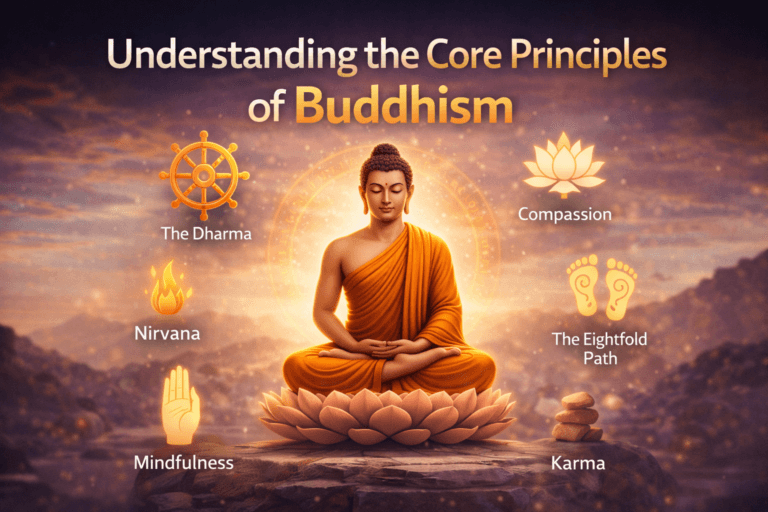
Buddhism, one of the world’s oldest spiritual traditions, offers profound insights into the nature of existence and the path to inner peace. At its heart lie core principles that guide practitioners toward enlightenment and liberation from suffering. Understanding these foundational teachings is essential for anyone seeking to explore or practice Buddhism meaningfully. This article delves into the essential principles of Buddhism, explaining their significance, context, and practical applications.
The Four Noble Truths
The cornerstone of Buddhist philosophy is the Four Noble Truths, articulated by Siddhartha Gautama (the Buddha) after his enlightenment. These truths diagnose the human condition and outline a path toward liberation.
- Dukkha – The Truth of Suffering
Life inherently involves suffering, dissatisfaction, and unease. This suffering (dukkha) ranges from obvious physical pain and emotional distress to subtler forms like impermanence and the fleeting nature of happiness. Recognizing that suffering is universal is the first step toward spiritual awakening. - Samudaya – The Origin of Suffering
Suffering arises from craving (tanha) and attachment. Desire for pleasure, existence, or non-existence fuels a cycle of dissatisfaction. Ignorance (avidya) of the true nature of reality perpetuates these cravings. - Nirodha – The Cessation of Suffering
It is possible to end suffering by extinguishing craving and attachment. This cessation is known as Nirvana, a state beyond pain and suffering, characterized by peace and freedom. - Magga – The Path to the Cessation of Suffering
The way to end suffering is through the Noble Eightfold Path, a practical guide to ethical living, mental discipline, and wisdom.
The Noble Eightfold Path
The Eightfold Path is a systematic approach to ethical and mental development aimed at freeing individuals from attachments and delusions.
- Right View (Samma Ditthi)
Understanding the Four Noble Truths and the nature of reality. It involves perceiving things as they truly are, not as we wish them to be. - Right Intention (Samma Sankappa)
Commitment to ethical and mental self-improvement. This includes intentions of renunciation, goodwill, and harmlessness. - Right Speech (Samma Vaca)
Speaking truthfully, avoiding slander, gossip, and harmful words. - Right Action (Samma Kammanta)
Acting ethically by abstaining from killing, stealing, and sexual misconduct. - Right Livelihood (Samma Ajiva)
Earning a living in a way that does not harm others or oneself. - Right Effort (Samma Vayama)
Cultivating positive states of mind and abandoning harmful ones through persistent effort. - Right Mindfulness (Samma Sati)
Developing awareness of body, feelings, mind, and phenomena to foster clear understanding. - Right Concentration (Samma Samadhi)
Practicing deep meditation to develop mental focus and tranquility.
The Three Marks of Existence
Buddhism teaches that all conditioned phenomena exhibit three fundamental characteristics:
- Anicca (Impermanence)
Everything is transient and constantly changing. Recognizing impermanence helps reduce attachment and suffering. - Dukkha (Suffering or Unsatisfactoriness)
Because all things are impermanent, clinging to them leads to dissatisfaction. - Anatta (Non-Self)
There is no permanent, unchanging self or soul. Understanding non-self dismantles ego and selfish desires.
The Five Precepts
For lay Buddhists, ethical conduct is foundational. The Five Precepts serve as moral guidelines to cultivate harmony and avoid harm:
- Abstain from taking life (non-violence toward all living beings)
- Abstain from taking what is not given (stealing)
- Abstain from sexual misconduct
- Abstain from false speech
- Abstain from intoxicating drinks and drugs that cloud the mind
Observing these precepts promotes personal integrity and social harmony.
Karma and Rebirth
Buddhism asserts the law of karma, the principle of cause and effect governing ethical actions. Positive intentions and deeds lead to beneficial outcomes, while negative actions result in suffering. Karma influences the cycle of samsara, the continuous process of birth, death, and rebirth.
Understanding karma encourages mindful living, as every action has consequences that shape future experiences. However, unlike fatalism, Buddhism emphasizes that individuals have the agency to transform their karma through conscious choices.
Meditation and Mindfulness
Meditation is a central practice in Buddhism aimed at cultivating insight and tranquility. Two primary forms are:
- Samatha (Calm-Abiding Meditation): Focuses on developing concentration and mental calm. Techniques include focusing on the breath or a mantra.
- Vipassana (Insight Meditation): Cultivates awareness of the impermanent and non-self nature of phenomena. It involves observing sensations, thoughts, and feelings without attachment.
Mindfulness (Sati) is the continuous attention to the present moment, fostering clarity and preventing the mind from becoming lost in distractions or negative emotions. This practice is widely adopted beyond religious contexts for stress reduction and emotional regulation.
Compassion and Loving-Kindness
Buddhism places great emphasis on cultivating Metta (loving-kindness) and Karuna (compassion). These qualities involve an unconditional wish for the well-being of all sentient beings and empathetic action to alleviate their suffering.
Compassion extends beyond mere feeling; it motivates ethical behavior and social engagement. The Bodhisattva ideal in Mahayana Buddhism exemplifies this principle, where practitioners vow to attain enlightenment for the sake of all beings.
The Middle Way
The Buddha advocated the Middle Way, a path between extremes of self-indulgence and self-mortification. This balanced approach avoids the pitfalls of hedonism and asceticism, promoting a harmonious lifestyle conducive to spiritual growth.
The Middle Way encourages moderation in all aspects of life, recognizing that excessive attachment or denial leads to suffering.
Dependent Origination (Paticca Samuppada)
This principle explains that all phenomena arise dependent on causes and conditions. Nothing exists independently; everything is interconnected in a complex web of relationships.
Understanding dependent origination reveals the emptiness (Shunyata) of inherent existence and helps dissolve attachment and ignorance. It provides a philosophical framework for comprehending the nature of reality and the processes that sustain suffering and liberation.
The Role of Sangha
The Sangha refers to the community of Buddhist practitioners, including monks, nuns, and lay followers. The Sangha provides support, guidance, and inspiration for individuals on the path.
Engaging with a Sangha fosters collective wisdom, ethical accountability, and shared practice. It emphasizes that spiritual progress is often nurtured through community.
Diverse Schools and Interpretations
While the core principles remain consistent, Buddhism encompasses diverse traditions such as Theravada, Mahayana, and Vajrayana, each with unique emphases and practices:
Theravada Buddhism emphasizes personal enlightenment through meditation, adherence to the Vinaya (monastic code), and insight into the Four Noble Truths. Predominantly practiced in Sri Lanka, Thailand, and Myanmar, it is often referred to as the “Teaching of the Elders.”
Mahayana Buddhism focuses on the Bodhisattva ideal, where practitioners aspire to attain enlightenment not just for themselves, but for the liberation of all sentient beings. This tradition encourages compassion, altruism, and the integration of wisdom and skillful means.
Vajrayana Buddhism, found mainly in Tibet and Mongolia, incorporates esoteric rituals, mantras, mandalas, and advanced meditation techniques. It blends philosophical teachings with symbolic and ritualistic practices to accelerate spiritual progress.
Despite these differences, all schools uphold the foundational principles of the Buddha, emphasizing mindfulness, ethical conduct, compassion, and the pursuit of liberation.
Practical Applications of Buddhist Teachings
Buddhism is not just a philosophy; it is a practical guide for daily life. Applying its teachings can lead to greater clarity, peace, and well-being:
Mindful Living: Integrating mindfulness into daily routines—eating, walking, or working—helps reduce stress and cultivate presence.
Ethical Conduct: Following precepts in personal and professional life fosters trust, harmony, and moral integrity.
Emotional Resilience: Meditation and mindfulness practices help manage anger, anxiety, and attachment, promoting inner calm.
Compassionate Engagement: Acts of kindness and empathy, inspired by Metta and Karuna, enhance social relationships and personal fulfillment.
Continuous Self-Reflection: Regular contemplation of impermanence, non-self, and dependent origination encourages personal growth and wisdom.
Conclusion
Buddhism offers a holistic approach to understanding life and alleviating suffering. Its core principles—Four Noble Truths, Noble Eightfold Path, Three Marks of Existence, Karma, Meditation, Compassion, and the Middle Way—serve as both philosophical insights and practical guides for daily living. Whether followed as a spiritual discipline or applied in a secular context, these teachings encourage mindfulness, ethical living, and compassionate action.
By embracing these principles, individuals can cultivate inner peace, resilience, and wisdom, ultimately moving closer to enlightenment and liberation from the cycles of suffering. Buddhism’s timeless relevance lies in its ability to provide guidance for navigating the complexities of human existence with clarity, balance, and compassion.