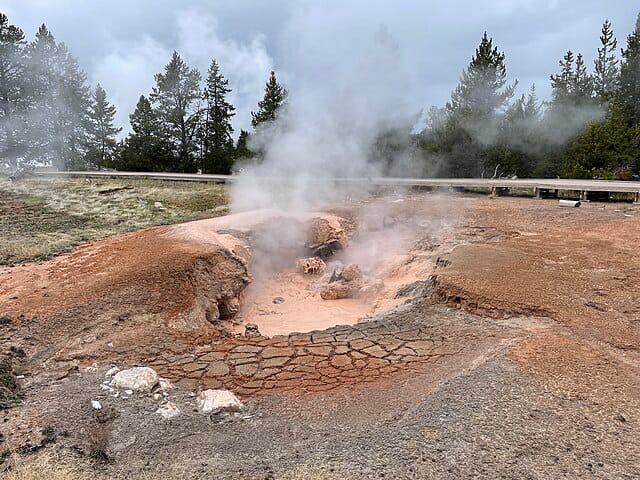
Yellowstone National forest is positioned above among the most completely taken a look at volcanic systems on earth. Below its forests, geyser basins, and river valleys lies a huge tank of partly molten rock, heat, and fluids that have actually affected the area for over 2 million years. As analytical strategies have actually advanced, clinical interest has actually grown, making it possible for more accurate dating of previous eruptions and their connections to bigger Earth system modifications. These insights extend beyond volcanology, converging with geomagnetic history, landscape development, and long-lasting evaluations of volcanic province habits with time. The disturbing element of Yellowstone is not the speculation of an impending catastrophe, however rather the scale and continuous nature of procedures taking place deep below the surface area.
How Repetitive Eruptions Formed Yellowstone
The Yellowstone Volcanic Field is identified by a series of caldera-forming eruptions sprinkled with smaller sized lava circulations. The most substantial occasions launched massive quantities of rhyolitic lava, triggering the ground above to collapse and forming calderas that cover 10s of kilometers. 3 significant eruptions are well-documented in the geological record, taking place around 2.08 million, 1.30 million, and 0.63 million years back. In between these significant occasions, the system knowledgeable various smaller sized eruptions that left domes and streams spread throughout the area.
Current research study has actually fine-tuned the timeline of the earliest volcanic cycles. High-precision dating of lava streams before and after the very first caldera-forming eruption suggests that the whole cycle happened over approximately 200,000 years, instead of the formerly presumed a lot longer period. This recommends that Yellowstone’s biggest lava tanks formed, emerged, and were partly charged over fairly quick geological timescales. The volcanic field did not keep a continuous level of activity; rather, it rotated in between eruptive stages and quieter durations lasting 10s of countless years, leading to a fragmented yet meaningful stratigraphic record throughout Wyoming, Idaho, and Montana.
How Yellowstone Stores and Renews Lava
Geophysical imaging and geochemical analyses expose that Yellowstone’s lava is not included in a single, completely molten chamber. Rather, it exists in zones of crystal-rich mush, with pockets of melt dispersed at numerous depths. The upper areas of this system lie within the crust, while much deeper sources extend into the upper mantle. Heat from listed below keeps these locations in a partly molten state, enabling lava to be activated when conditions agree with.
The timing of small-volume eruptions following caldera development supplies insights into the length of time lava can stay below the surface area before appearing. Dating of rhyolitic circulations related to the preliminary volcanic cycle suggests that post-caldera lava reached the surface area within around 100,000 years of the primary eruption, with subsequent eruptions taking place at much shorter periods. These findings recommend recharge and storage times of less than 40,000 years for particular lava batches. Such periods are fairly brief in geological terms, showing a system efficient in quick reorganization following substantial interruptions. The continuous existence of heat and melt below Yellowstone today shows this sustaining capability for renewal instead of a progressive build-up towards a particular result.
How Yellowstone Records Earth’s Magnetic Previous
As lava cools, magnetic minerals line up with Earth’s existing electromagnetic field instructions and end up being secured location. This enables scientists to make use of the age of the lava circulation together with paleomagnetic measurements to identify when shifts happened in between various geomagnetic polarities. A research study released in the journal Earth and Planetary Science Letters shows that streams from Yellowstone’s very first volcanic duration consist of both typical (favorable) and reversed (unfavorable) magnetic polarities throughout an unsteady stage in the Matuyama amount of time. These records are essential for developing the timing of the beginning of the Olduvai subchron and work as terrestrial markers for associating marine sediment records of magnetic adventures. Nevertheless, the significance of these records extends well beyond the field of geophysics.
The geomagnetic timescale is used to date sediments and fossils internationally, consisting of websites essential for comprehending early human development. Therefore, the volcanic history below Yellowstone is straight connected to international sequential structures.
What Yellowstone’s Past States About Its Future
Public discourse surrounding Yellowstone frequently concentrates on the capacity for a future supereruption. From a clinical viewpoint, a more helpful technique includes taking a look at the system’s habits over duplicated cycles. The geological record exposes irregularity instead of predictability. Later on volcanic cycles appear to have actually lasted longer than the preliminary ones, with activity crossing a number of hundred thousand years and consisting of extended durations of inactivity. The most current caldera-forming eruption occurred over 600,000 years back, followed by rhyolitic eruptions that continued up until about 75,000 years back.
Measurements of ground contortion, seismic activity, and gas emissions suggest that lava and fluids are still in movement below the park. These observations verify that Yellowstone is an active volcanic system, however they do not recommend a particular trajectory. The disturbing truth depends on acknowledging that enormous geological procedures are continually at work below a landscape frequently related to stability and natural appeal. What science exposes is not an instant danger, however rather a vibrant system whose historic habits is maintained in rock, magnetism, and time, offering an in-depth yet humbling insight into the functions of the Earth’s interior.
Read other such interesting post
New Discovery Confirms Einstein: Black Holes Are Twisting the Universe